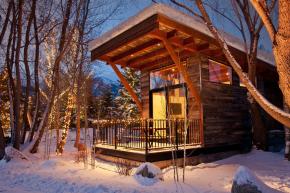
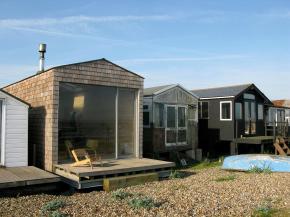
The Wedge is a small transportable cabin designed and built by WheelHaus. It is a park model trailer, built on a trailer chassis and registered as a recreational vehicle (RV). A park model trailer is typically used as a vacation cottage or small retirement home, but would also make an affordable home for a young single person or couple. Although they can be moved occasionally, park models are primarily designed to be left in one location and hooked up to utility services there. Because they are legally registered as RV’s, they can be placed in RV parks and mobile home parks. Park models in the United States are restricted by federal regulations to a maximum of 400 ft2 (37 m 2).
Monthly Archives: November 2012
Haus Bru 1.25, a barn-like home by SoHo Architektur
Haus Bru 1.25 is a small house by architect Alexander Nägele of SoHo Architektur. It was designed to make the most of a limited budget. Although built in Germany, the austere form and economy of materials remind us of a New England barn. The irregular window placement adds to the utilitarian appearance, having seemingly been driven by interior function with no regard for exterior appearance. However each facade has in fact been carefully balanced. Not everyone will appreciate the barn-like styling, but to us the proportions are pleasing and the arrangement of the variously-sized square openings is quite interesting.
Weekend Fun: Writer’s Block I by Cheng + Snyder
This small structure in Maine was designed by architects Cheng + Snyder for use as a combination writing studio and boat shed. From a distance it appears to be an ordinary shingled shed, but up close it offers a number of surprises. Something about the building seems a bit off but it is difficult to pin down what it is at first glance. The lack of overhangs together with uniform wall and roof shingles gives it a somewhat plastic appearance, as if it had been molded in one piece rather than assembled. Unlike the traditional shed, this one has windows wrapping around the corners, plus one that wraps up onto the roof. All the windows have been recessed into the walls, giving them an unusual appearance. The absence of any obvious entrance door only adds to the enigmatic nature of this small outbuilding.
The E.D.G.E., a small prefab house by Revelations Architects/Builders
Following the 2006 housing market crash in the United States, Revelations Architects/Builders set out to design a small house alternative to the bloated McMansion that had become so prevalent there. They aimed to distill housing down to the basics of providing space for eating, sleeping, bathing and socializing, while making efficient use of resources.
The result was the E.D.G.E. (Experimental Dwelling for a Greener Environment). It consists of two modules containing the service areas of the house, with the kitchen in one and the bathroom in the other. The modules are intended to be prefabricated, ensuring that the plumbing, mechanical and cabinetry work is done in a controlled setting. Once those modules have been put in place, the space between is filled in with walls of glass to enclose the living/dining area. The whole structure is covered by a butterfly roof (one that slopes towards the center), facilitating rain-water collection. Utilities are housed in a small bump-out at one end of the house.
“Gate”, a small house with a dynamic interior by mihadesign
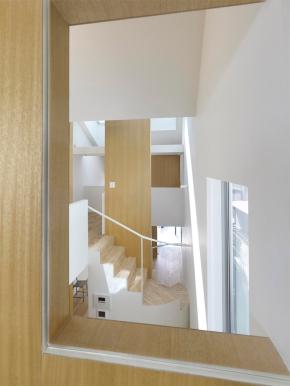
This small Japanese house is fairly unremarkable on the outside. It is interesting enough with its green metal cladding and inset entry, but not particularly outstanding. Step inside though and the Gate house leaves a very different impression. For such a small house it has an extremely visually stimulating interior. There are unexpected openings and views no matter where you look.
The Gate house sits on a narrow lot in Tokyo. With only 4.5 m (14′ 9″) of width to work with, the house had to be long and skinny. And with neighboring houses sitting close by on both sides, there was limited opportunity to provide views to the outdoors from all rooms. Instead, the architects from mihadesign created a dynamic interior to engage the occupants at every turn, substituting interesting internal views for external ones.
Fish Creek Guest House, a small modern home by Carney Logan Burke
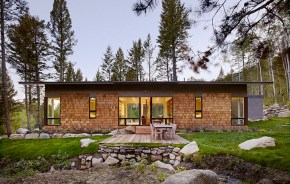
Architect Jim Carney of Carney Logan Burke Architects designed this small modern house for his wife and himself. It is intended to become their guest house, but they are living in it for now while designing their main house. The architect states that one of the design goals was to “immerse the owners in the experience of the forest both visually and aurally.” The former was accomplished by the large windows in every room, and the latter by siting the house within earshot of a rushing stream.
Casa Apolo 11, a secluded forest retreat by Parra + Edwards
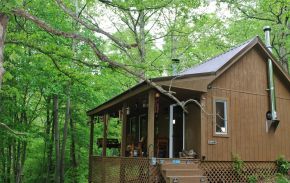
This small 2-story house sits in a deciduous forest on the outskirts of Santiago, Chile. It was designed by Parra + Edwards Arquitectos. The house is a simple rectangular box given architectural interest by the patchwork pattern of alternating glass and solid wall.
Supposedly it was named for Apollo 11 because it was conceived to be “like a ship that landed in a forest without touching it at any time and will undertake its departure, leaving the forest intact.” That sounds like pure architectural hubris; no one but an architect would imagine that a house could be built in a formerly untouched forest with no impact. However with the largely transparent lower level, the more solid-walled upper level does appear from some angles to be hovering like a spaceship.
Casa B8, a modern beach house in Chile by 56.02 Architects
Casa B8 is a small modern house located on the coast of Chile. Designed by architects 56.02, it consists of two simple rectangular blocks joined by a deck. One block contains the living area and a bedroom, while the second one, at half the size, is used as a guest suite. Between the two blocks is a courtyard patio protected on a third side by a storage wall that also houses a barbecue cooking area. The front door of the house actually provides entrance to this courtyard rather than going directly inside. Having a sheltered outdoor space was important as the area is subject to frequent high winds blowing in from the Pacific.