Small House Bliss

Small house designs with big impact


1 Comment

Weekend Fun: Flake House by OLGGA Architects

photo by Fabienne Delafraye

It’s Friday and time for a bit of weekend fun. And this is a fun little project, a tiny shed-roofed retreat built to resemble a stack of logs that has been snapped in half. Consider it post-modern log cabin.

Continue Reading →


1 Comment

Solar Decathlon Europe: The Odoo House

© Solar Decathlon Europe

Solar Decathlon Europe 2012

Solar Decathlon Europe 2012 is now in full swing in Madrid, Spain. Solar Decathlon Europe is an offshoot of the U.S. Department of Energy’s Solar Decathlon held every second year in Washington, D.C. Interest in the U.S. competition had grown to the point that a European version was started in 2010. The U.S. competition invites international entrants but the cost of travel and shipping a house overseas was prohibitive for many potential teams. A European version allows participation by many more teams.

In the Solar Decathlons, university teams compete in the design, construction and operation of small energy-efficient houses powered by the sun’s energy. The Solar Decathlon Europe’s teams are judged in these ten contests: architecture, engineering and construction, energy efficiency, electrical energy balance, comfort, function, communication / raising social awareness, industrialization / market viability, innovation, and sustainability.

We will be having a look at several of this year’s Solar Decathlon Europe entries. First up is the Odoo House by team Odooproject from the Budapest University of Technology and Economics in Hungary.

Continue Reading →


Leave a comment

The Stripe House by GAAGA Studio Architecture

photo by Marcel van der Burg

The Stripe House is a new home in the Netherlands designed by GAAGA Studio Architecture. It is built in a new neighborhood of rowhouses where the parcels were sold as bare land and each owner had their house individually designed. Unlike most of the neighboring houses, the Stripe House is set back from the front property line. Because the house fronts on a narrow pedestrian street, the architects increased the separation from the houses opposite by creating a small entry court that takes up a quarter of the lot. They compensated for the lost building area by going up with a three story structure. The name Stripe House refers to the horizontal grooves troweled into the exterior stucco finish, adding texture and refinement to facades that would otherwise have appeared somewhat monotonous. The other obvious feature of the exterior is the enormous, storefront-sized windows. Note though that some of the windows are flanked by white panels that make them appear larger than they really are.

Continue Reading →


Leave a comment

Design: Good planning enriches a modest cottage

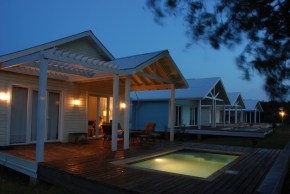
This two-bedroom cottage is located on the island of Utila in Honduras. A single-level residence, it’s the type of small house often found in retirement communities across North America. It appears to be a fairly low-cost home. The layout is pretty humdrum and it is finished with builder standard drywall and laminate flooring. But even when building on a tight budget, relatively inexpensive features can have enormous impact, as architect Mark Zacapa demonstrates here.

Continue Reading →


3 Comments

Eel’s Nest by Anonymous Architects

photo by Steve King

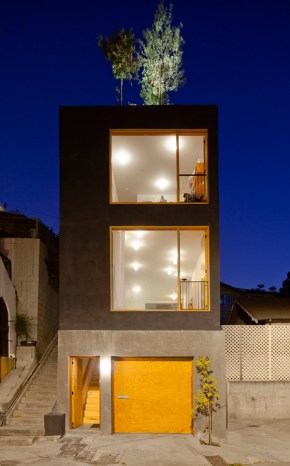
The Eel’s Nest is a small modern house in Los Angeles, California built on a steep and tiny lot of 15′ by 52′ (about 4.6 m by 15.8 m). It’s not uncommon to find rowhouses built on similarly-sized lots in some North American cities, but lots that small are extremely rare in Los Angeles. The name “Eel’s Nest” comes from the term used in Japan to describe very narrow building lots.

As the property is located in a neighborhood that is starting to densify with townhouses and small apartment buildings, architect Simon Storey of Anonymous Architects applied to the city for planning permission to build an extra story in height. With permission granted, the architect designed a house that stretches vertically and from lot line to lot line, achieving the maximum possible floor area. It has 960 ft2 (89.2 m2) of space divided over two floors, plus a garage tucked below. The lack of side setbacks did necessitate the use of a fire-rated exterior finish, for which Storey chose cement plaster.

Continue Reading →


Leave a comment

Weekend Fun: Sunset Cabin by Taylor Smyth Architects

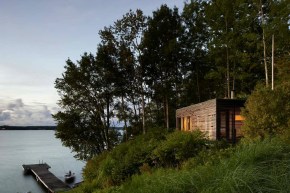
The Sunset Cabin merges into the landscape of its shoreline setting on Lake Simcoe in Ontario, Canada. Designed by Taylor Smyth Architects, it is a highly refined variant of the traditional cottage country “bunkie”, a tiny cabin used to provide additional sleeping quarters for the main cottage or cabin. At 275 ft2 (25.5 m2), this one is larger than most. There is room for a full-sized bed with storage drawers below, a couple of good-sized closets and a small sitting area around the wood stove. And, unlike most bunkies, the Sunset Cabin has its own bathroom consisting of a composting toilet and an outdoor shower with a view of the lake.

Continue Reading →


Leave a comment

“Life in Spiral” by Hideaki Takayanagi

This small house in Tokyo sits on a tiny lot in a neighborhood of apartment buildings. Because of the small lot size, the only way to get sufficient living area was to build up, four stories tall. From the outside, the most distinguishing characteristic of the boxy house are the two glass facades which reveal a staircase winding around the perimeter of the home. On the inside, that staircase defines the character of the space. A tightly-wound staircase that zig-zagged back and forth over itself would have been more space-efficient. Instead, architect Hideaki Takayanagi opted for a stair that rises in a wide arc, sacrificing some space in favor of architectural interest.

Continue Reading →


5 Comments

The Silberfisch, a modern floating home by Confused-Direction

courtesy of SchwimmHausBoot

Living on the water is an option in many places. Unlike a houseboat, a float home has no engine of its own and must be towed from place to place. They are typically left moored in one location and not moved often. In many cities where berths are limited and water views are highly-sought, living in a float house is very costly. However in some places, float homes can be a very affordable housing alternative.

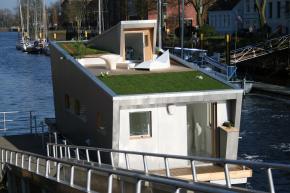
The Silberfisch (silver fish) was designed by Flo Florian and Sascha Akkermann of German design firm Confused-Direction. Their stated aim was to “create a quality home that represents a balanced mix of design and a maritime romance”, and they have succeeded. The wedge shape is fresh and at the same time reminiscent of the industrial sheds that line any working port.

Continue Reading →

Follow

Get every new post delivered to your Inbox.

Join 384 other followers